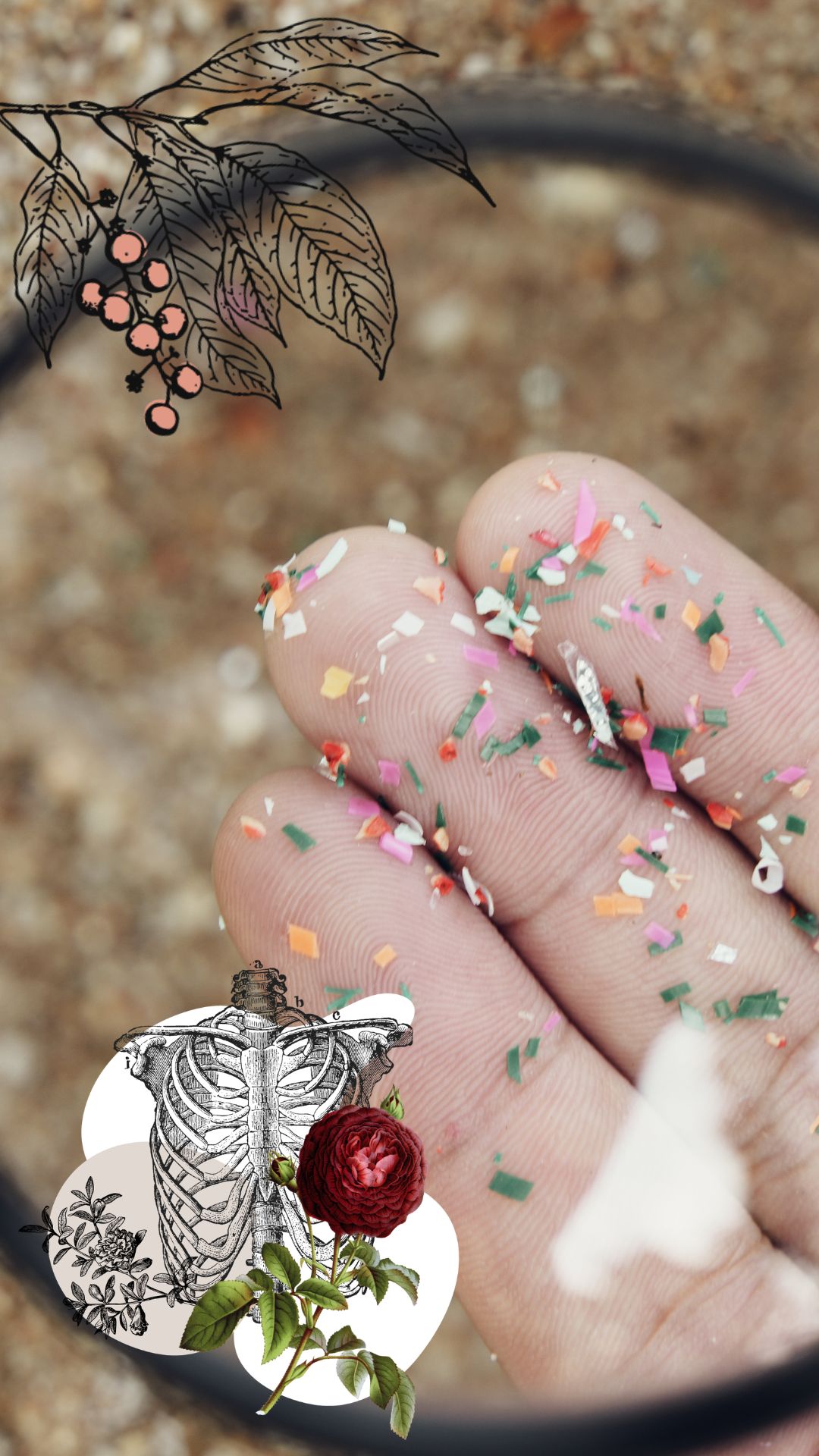
In many ways, we are making our world more and more unnatural. It’s an interesting reflection to consider that natural organisms are the creators of all of this lack of naturalism! Non-organic particles are becoming more and more prevalent in our lives, so much so that we can now detect them within our bodies. An insidious embodiment of the Made in China culture we have all bought into.
Microplastics are plastic particles generally smaller than five millimetres; nanoplastics are smaller still and are capable of crossing biological barriers. A biological barrier might be your skin, your gut lining or even deeper, a blood vessel’s lining. Nanoplastics are now present in air, water, soil and food and – increasingly – researchers are detecting them inside human tissues. Finding a particle, however, does not automatically prove that it is causing disease. There are also many more confounding, unnatural entities in our environment that it’s difficult to know which alien innovation is causing which human ill.
How are we exposed?
The principal routes appear to be eating, drinking and inhaling through our lungs. Another entry point is medical equipment. While having an iron infusion recently, I reflected on the nano plastics that might have been accompanying that energy giving iron into my veins. Potential sources include bottled water, food contaminated during production, preparation or packaging, airborne household dust, synthetic textiles, tyre wear and degraded plastic products. Your skin has about 50 layers of skin cells, our gut lining is a single celled lining that I like to liken to an intelligent cellophane sheath. While absorption through our skin appears to be limited by the integrity of skin as a protective barrier, our guts are highly absorptive and so are our lungs.
Once swallowed, most larger particles are probably excreted. Smaller particles may cross the intestinal lining through specialised immune-sampling cells, gaps in a disrupted barrier or uptake by intestinal cells. Inhaled particles may be cleared in mucus and swallowed, while sufficiently small particles may reach deep into lung tissue. From there, a fraction may enter blood or lymph and distribute to organs. Exactly what proportion is absorbed, retained or eliminated in humans remains unknown.
Plastics in testicular tissue
In 2024, researchers analysed 23 archived human testes obtained at post-mortem examination and 47 canine samples. Why they archived 47 dog’s testicles could be of interest all on its own, but we will put that aside for now. Microplastics were detected in every sample. The average measured concentration was higher in the human tissue when compared to the dogs. Polyethylene, the plastic most commonly used in bags, films and containers was the dominant polymer.
This finding confirms that plastic particles are reaching human organs and organising themselves within out anatomical architecture. We can hypothesize the impact that microplastics embedded deep in our body’s tissue might have on our immune response and general organ function.
Another major study analysed carotid plaques surgically removed from 257 patients. A carotid plaque refers to the cholesterol (now cholesterol and plastic!) deposits found in the neck arteries of patients with Atherosclerotic disease. Polyethylene was found in plaques from 58% of participants and polyvinyl chloride in 12%. Patients who were followed in this study that had confirmed and detected micro- or nanoplastics experienced more heart attacks, strokes or deaths during approximately three years of follow-up. Their plaques also showed more inflammatory activity. The more inflammation we experience in our vascular system, the greater risk we have for heart disease, stroke and embolism.
Exposure to microplastics within the body have been linked to oxidative stress (resulting in DNA damage), inflammation, altered testosterone signalling, injury to sperm-producing cells and impaired sperm concentration, motility or morphology. Human studies are not yet strong enough to determine whether everyday exposure reduces fertility or at what dose. It’s interesting to me too, that when asking ChatGPT to assist me with content for this article, that he/she seemed very reluctant to raise any alarm bells. If I had detectable plastic in my ovaries, I would ring an alarm bell. I don’t mean to be alarmist, but I think we have a problem here that no one is talking about.
A possible inflammatory pathway
All of the systems within our bodies are designed to switch on when there is a problem and then switch off when the problem is gone. In the same way that perpetual stress dysregulates our nervous systems and pre disposes us to burn out, depression and anxiety and as a result increases our risk for heart disease and other chronic afflictions, housing plastic within human tissue is certainly likely to be messing with our immune systems. If you had foreign particles drifting into your circulation every time you drank from a plastic bottle or ate a meal heated in the microwave out of a plastic container, your immune system would likely be switched on and working overtime. We know that when any system works overtime, it eventually burns out or starts dropping balls; human systems included. Take heed.
In the case of all of those poor archived testes (I have a laugh every time I write that); reproductive tissues, similar responses could theoretically disturb the specialised immune environment of the testes, damaging supporting cells, impairing mitochondrial function or affecting the blood–testis barrier. Plastics may also carry additives or environmental contaminants with endocrine-disrupting properties. These mechanisms are biologically plausible but yet to be proven and I imagine anyone on the path to raising that red flag is likely to be knocked over.
What do we still not know?
We do not yet have standardised methods for measuring microplastics across studies. We lack reliable data on individual exposure, absorption, tissue clearance, dose–response relationships and the relative importance of particle size, shape, polymer and chemical additives. This makes it difficult for regulators, but we are talking about massive industries that span food, building, pharmaceuticals and health products. The FDA states that existing evidence does not demonstrate that microplastic levels detected in food pose a proven human-health risk, but this is the same organisation that allows exposure to pesticides [SS1] that we know are toxic.
Practical ways to lower exposure
If you hadn’t given this much thought before and are rueing the day you opened this newsletter, I am sorry, not sorry. As consumers, our only hope is to push back and hope for a better future. We should also be mindful that while we may be over 40 and done with reproducing, our children are yet to get here. Imagine how many microplastics we will find in the testicles of children who were born today in 40 years if we don’t make some changes.
It is beginning to feel like we are damned if we do and we are damned if we don’t, but there are simple things you can do from today to reduce your and your family’s exposure:
- Store and reheat all food in glass, stainless steel or ceramic, particularly when food is hot, oily or acidic.
- Avoid microwaving plastic even if specified to be safe.
- Replace scratched, cloudy or degraded containers.
- Use reusable glass or stainless-steel bottles where practical, rather than routinely drinking bottled water.
- Reduce reliance on takeaway containers and plastic-lined disposable cups.
- Avoid pouring boiling water over plastic tea bags or using plastic utensils in very hot food[SS2] [LP3] .
- Wash hands before eating and reduce indoor dust through ventilation, air purifiers, damp dusting and vacuuming.
- Check cosmetics for terms such as polyethylene, polypropylene, polymethyl methacrylate, nylon or acrylate copolymers. Skin absorption of intact particles is probably limited, but avoiding deliberately added plastic particles also reduces environmental release.
- Do not compromise hydration, nutrition or food safety to avoid plastic. The benefit of eating a varied, minimally processed diet remains far better established than the benefit of avoiding any single packaged food. This is important. Don’t be crazy.
It’s an irony that organic foods are the most expensive and that glass costs more than plastic, but if we are aware, awake and strategic, we can do better for ourselves and – especially – for our children.
References
- Hu CJ, et al. Microplastic presence in dog and human testis and its potential association with sperm count and weights of testis and epididymis. Toxicological Sciences. 2024;200(2):235–240.
- Marfella R, et al. Microplastics and Nanoplastics in Atheromas and Cardiovascular Events. New England Journal of Medicine. 2024;390:900–910.
- World Health Organization. Dietary and inhalation exposure to nano- and microplastic particles and potential implications for human health. 2022.
- US Food and Drug Administration. Microplastics and Nanoplastics in Foods. Updated 2024.
- Sun A, et al. Human Exposure to Microplastics and Its Associated Health Risks. Environment & Health. 2023.
____________________________________________________
[SS1]check true –
[SS2]are there non plastic tea bags? what were they made of before
[LP3]Yes. **Plastic-free tea bags do exist**, and tea bags were originally made without plastic. The plastic issue is largely a result of more modern manufacturing methods.
### What were tea bags traditionally made from?
Early tea bags in the **early 1900s** were commonly made from **silk or fine cloth**, before manufacturers moved towards **paper-based filter materials**.
For much of the 20th century, the familiar tea bag was primarily made from a porous filter paper consisting of **plant-derived fibres**, such as:
* **Abacá** – a strong natural fibre from a banana relative
* **Wood pulp/cellulose**
* Sometimes other natural plant fibres
The complication came when manufacturers began **heat-sealing** tea bags. A small amount of thermoplastic, commonly **polypropylene**, could be incorporated into the paper fibres so the edges would bond when heated. So even a tea bag that *looks* completely like paper may contain some plastic.
### What are plastic-free tea bags made from today?
There are several alternatives. Some brands use **100% plant-fibre paper**, with the bag folded, stitched, or otherwise sealed without polypropylene. Others use materials such as **abacá, cellulose, cotton, or other plant fibres**.
You may also see transparent or pyramid-shaped bags marketed as “plant-based.” These are often made from **PLA (polylactic acid)**, a bioplastic typically derived from corn starch or sugarcane. PLA is plant-derived, but it is **still a type of plastic** and usually requires industrial composting conditions to break down properly. So “plant-based” and “biodegradable” don’t necessarily mean **plastic-free**.
If you specifically want to avoid plastic, **loose-leaf tea in a stainless-steel infuser** is the simplest option. Otherwise, look for brands that explicitly state **”plastic-free tea bags” or “no polypropylene/PLA.”**
Interestingly, the old-fashioned solution was arguably the simplest: **paper and plant fibres, without needing a plastic heat seal.**


